
Conversion questions at Level 2 are rarely just ‘convert 3.5 km to metres’. They hide inside a delivery weight limit, a recipe in ounces, a fuel price per litre against a tank in gallons. This free worksheet covers the metric system, the imperial approximations the exam gives you, and time, with the working shown.
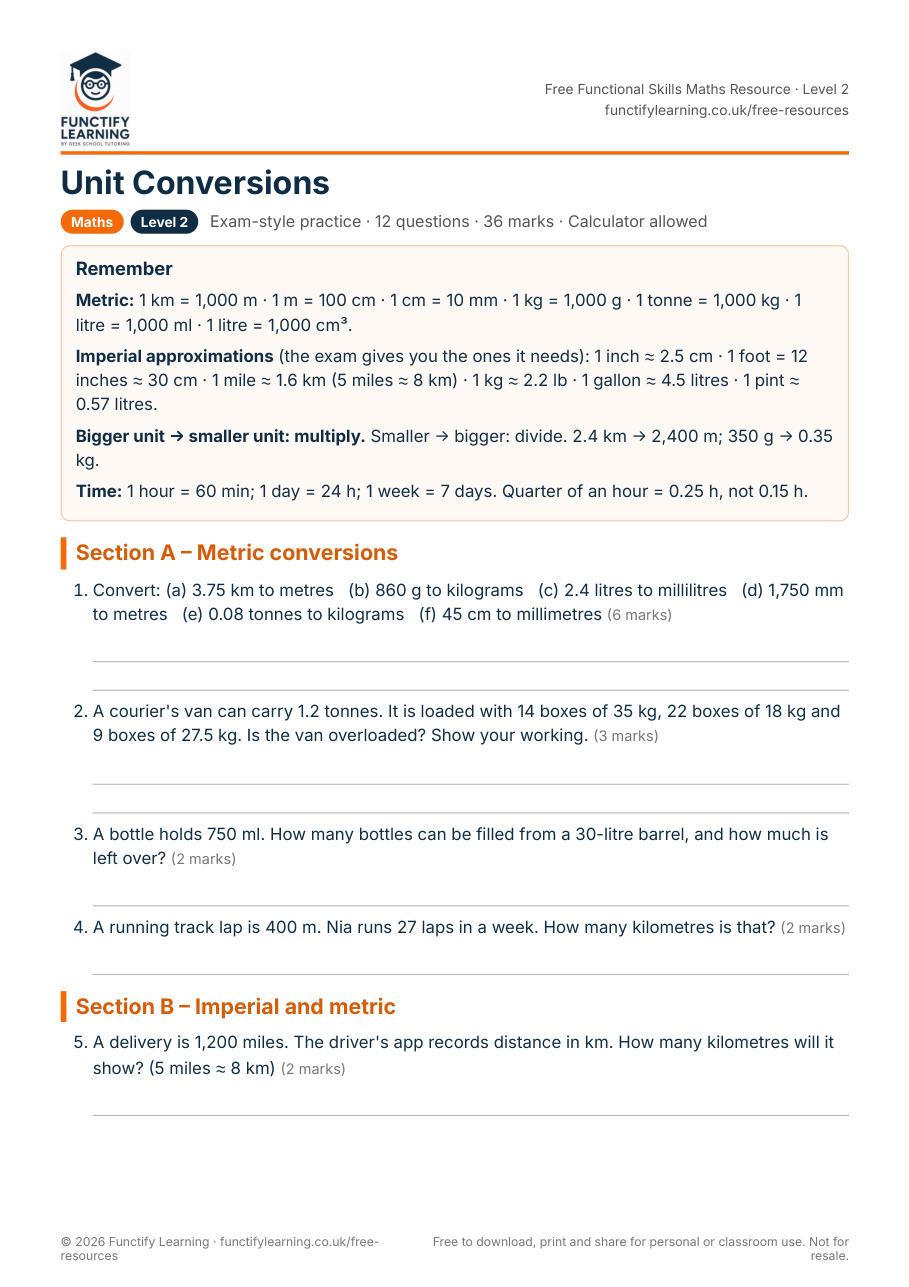
Free to download, print and share for personal or classroom use. Answers included.
What’s in this worksheet
- Section A – Metric conversions (13 marks)
- Section B – Imperial and metric (14 marks)
- Section C – Time and mixed (9 marks)
- Revise box with the rules and methods for the topic
- Worked answers for every question
Common mistakes on this topic
From our tutors’ marking and the most recent examiner reports – check your work against these:
- Multiplying when you should divide: 860 g → 860,000 kg. Ask: should the number get bigger or smaller?
- Treating 6 ft 6 in as 6.6 ft. There are 12 inches in a foot, so it is 6.5 ft.
- Adding hours and minutes as decimals (12.30 × 3 = 36.90). Work in minutes or carry at 60.
How to use it
- Print the worksheet (or work on screen) and attempt every question without looking at the answers. Give yourself a rough time limit – Level 2 exams are tight.
- Mark your work against the answer page. For maths, check the method as well as the final number; method marks are where most of the marks are.
- Read the ‘common mistakes’ notes below and check whether any of them happened to you. Then redo the questions you got wrong a day later.
Related free resources
- Using Length, Area and Volume in Calculations Worksheet – Functional Skills Maths Level 2
- Conversion Graphs Worksheet – Functional Skills Maths Level 2
- Level 2 Maths Mini Practice Paper 1 – Functional Skills Maths Level 2
- All free Functional Skills Maths Level 2 resources
Frequently asked questions
Which imperial conversions do I need to remember for Functional Skills?
The exam normally gives you the conversion it wants you to use, but knowing the common approximations saves time: 1 inch ≈ 2.5 cm, 1 foot ≈ 30 cm, 5 miles ≈ 8 km, 1 kg ≈ 2.2 lb, 1 gallon ≈ 4.5 litres, 1 pint ≈ 0.57 litres.
How do I know whether to multiply or divide when converting?
Going from a bigger unit to a smaller one (km to m, kg to g) gives a bigger number, so multiply. Going from smaller to bigger, divide. Check the answer makes sense: 860 g must be less than 1 kg.
How many cm³ are in a litre?
1,000. A litre is a cube 10 cm × 10 cm × 10 cm. So a container of 2,400 cm³ holds 2.4 litres – this comes up in volume questions.
Want a tutor to mark your work? Not sure where you stand? Take the free 15-minute mini mock test. Ready to get qualified? Our live 10-week Functional Skills Level 2 Maths course runs in small groups with a mock exam included, and the 5-day revision course is there if your exam is close.