
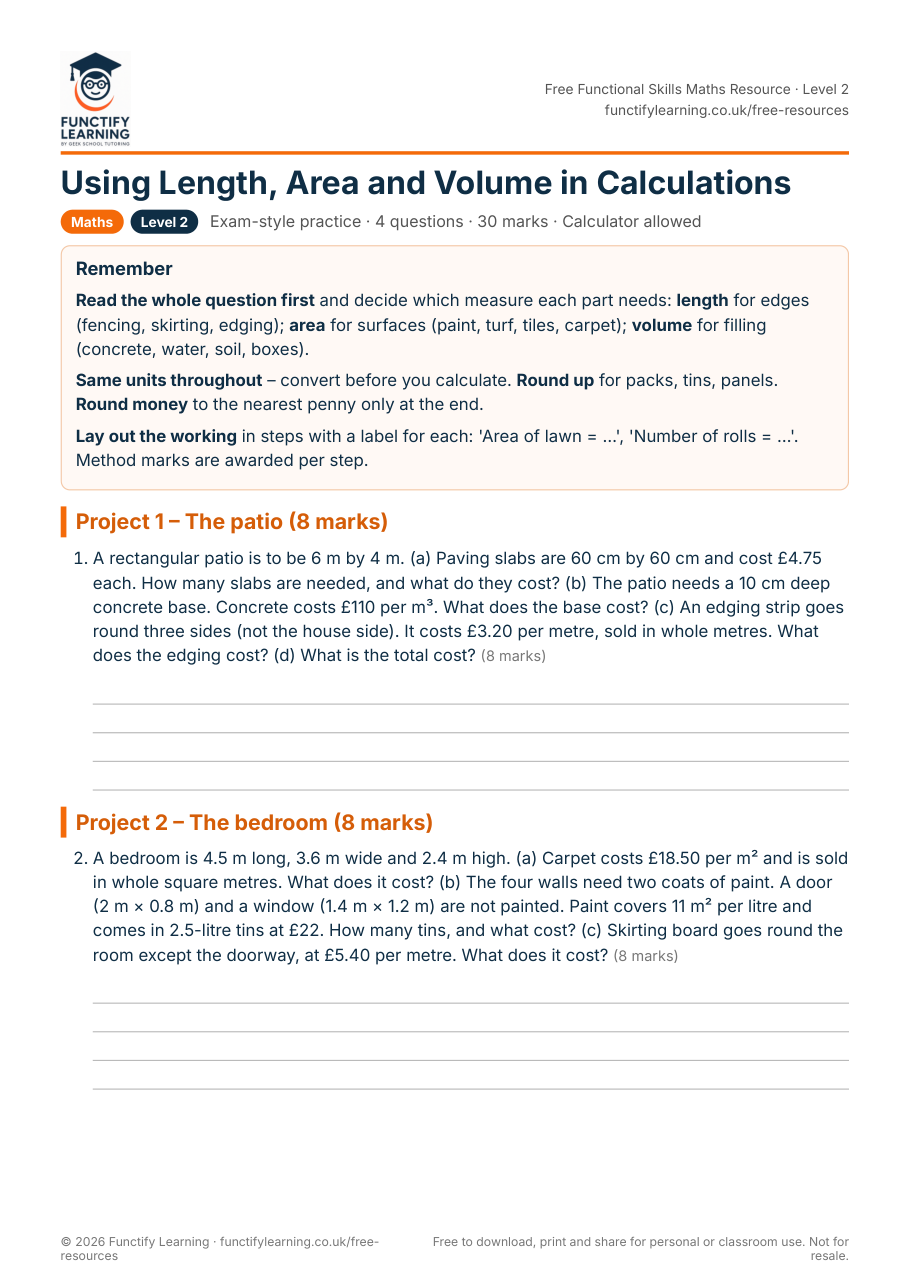
This is where the exam puts its longest questions: a whole project – a patio, a room makeover, a storage unit – that needs perimeter for one part, area for another and volume for a third, with costs and rounding at the end. This free worksheet is six of those multi-step problems, each with a fully worked solution so you can see how to lay out the working.
Free to download, print and share for personal or classroom use. Answers included.
What’s in this worksheet
- Project 1 – The patio (8 marks) (8 marks)
- Project 2 – The bedroom (8 marks) (8 marks)
- Project 3 – The raised bed (7 marks) (7 marks)
- Project 4 – The fish tank (7 marks) (7 marks)
- Revise box with the rules and methods for the topic
- Worked answers for every question
Common mistakes on this topic
From our tutors’ marking and the most recent examiner reports – check your work against these:
- Using the tank’s full height (50 cm) when it is filled to 45 cm.
- Rounding 2.16 bags down to 2 – you would be 0.12 m³ short.
- Losing track of which unit each figure is in halfway through a long question. Write the unit after every number.
How to use it
- Print the worksheet (or work on screen) and attempt every question without looking at the answers. Give yourself a rough time limit – Level 2 exams are tight.
- Mark your work against the answer page. For maths, check the method as well as the final number; method marks are where most of the marks are.
- Read the ‘common mistakes’ notes below and check whether any of them happened to you. Then redo the questions you got wrong a day later.
Related free resources
- Angles in 2D Shapes Worksheet – Functional Skills Maths Level 2
- Unit Conversions Worksheet – Functional Skills Maths Level 2
- Level 2 Maths Mini Practice Paper 1 – Functional Skills Maths Level 2
- All free Functional Skills Maths Level 2 resources
Frequently asked questions
How do I know whether a question wants perimeter, area or volume?
Ask what is being measured. Edges and borders (fencing, skirting, edging strip) are perimeter. Surfaces (carpet, paint, turf, tiles) are area. Anything that fills a space (concrete, soil, water, boxes) is volume.
How should I set out a long multi-step question?
One line per step, each labelled with what it is and its unit: ‘Area of walls = 38.88 m²’, ‘Litres needed = 6.47’. Examiners award method marks for each correct step even if a later step goes wrong.
Why does the number of slabs sometimes differ from area ÷ slab area?
Because whole slabs are laid in rows. A 4 m width needs 7 rows of 60 cm slabs (6.67 rounded up), so 10 × 7 = 70 slabs, even though 24 m² ÷ 0.36 m² is only 66.7. Either method with clear reasoning is usually accepted, but the row method is what a builder would do.
Want a tutor to mark your work? Not sure where you stand? Take the free 15-minute mini mock test. Ready to get qualified? Our live 10-week Functional Skills Level 2 Maths course runs in small groups with a mock exam included, and the 5-day revision course is there if your exam is close.