
Money is the context for more Level 2 questions than any other – wage slips, household budgets, deposit-and-instalment deals, VAT, profit and loss. This free worksheet works through the calculations the exam sets, including the ‘is it enough?’ and ‘which is better value?’ decisions that carry the final mark.
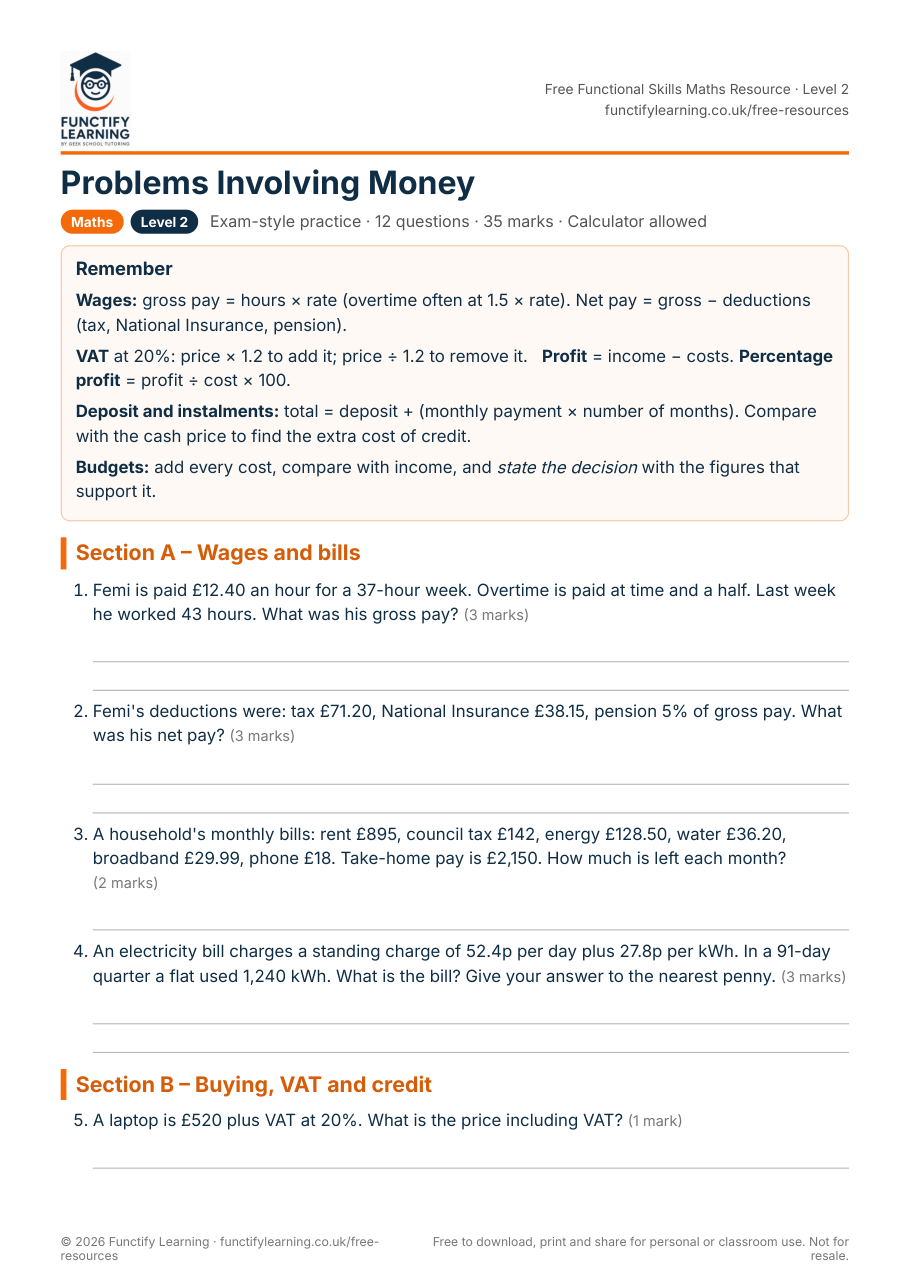
Free to download, print and share for personal or classroom use. Answers included.
What’s in this worksheet
- Section A – Wages and bills (11 marks)
- Section B – Buying, VAT and credit (12 marks)
- Section C – Profit, budgets and decisions (12 marks)
- Revise box with the rules and methods for the topic
- Worked answers for every question
Common mistakes on this topic
From our tutors’ marking and the most recent examiner reports – check your work against these:
- Paying overtime hours at the normal rate, or paying all 43 hours at time and a half.
- Finding VAT on a price that already includes it by taking 20% of it (1,860 × 0.2 = 372 – wrong). Divide by 1.2 first.
- Doing all the arithmetic correctly and then not answering the question: ‘does the school cover its costs?’ needs a yes/no and the difference.
How to use it
- Print the worksheet (or work on screen) and attempt every question without looking at the answers. Give yourself a rough time limit – Level 2 exams are tight.
- Mark your work against the answer page. For maths, check the method as well as the final number; method marks are where most of the marks are.
- Read the ‘common mistakes’ notes below and check whether any of them happened to you. Then redo the questions you got wrong a day later.
Related free resources
- Conversion Graphs Worksheet – Functional Skills Maths Level 2
- Best Buys and Value for Money Worksheet – Functional Skills Maths Level 2
- Level 2 Maths Mini Practice Paper 1 – Functional Skills Maths Level 2
- All free Functional Skills Maths Level 2 resources
Frequently asked questions
How do you work out overtime pay?
Overtime at ‘time and a half’ means 1.5 × the normal hourly rate. Work out normal hours at the normal rate, the extra hours at the higher rate, and add. £12.40 an hour becomes £18.60 for overtime.
How do I take VAT off a price?
Divide by 1.2 (for 20% VAT) to get the price before VAT, then subtract to find the VAT itself. £1,860 ÷ 1.2 = £1,550, so the VAT is £310. Do not take 20% of the inclusive price.
What is the difference between gross pay and net pay?
Gross pay is everything earned before deductions. Net pay (take-home pay) is what is left after tax, National Insurance, pension and any other deductions are taken off.
Want a tutor to mark your work? Not sure where you stand? Take the free 15-minute mini mock test. Ready to get qualified? Our live 10-week Functional Skills Level 2 Maths course runs in small groups with a mock exam included, and the 5-day revision course is there if your exam is close.