
Surface area is the total area of all the faces – the card to make a box, the paint to cover a tank, the paper to wrap a parcel. Level 2 questions usually involve a cuboid or cylinder and a cost, and the classic trap is a box with no lid. This free worksheet covers the solids the exam uses and those open-top problems.
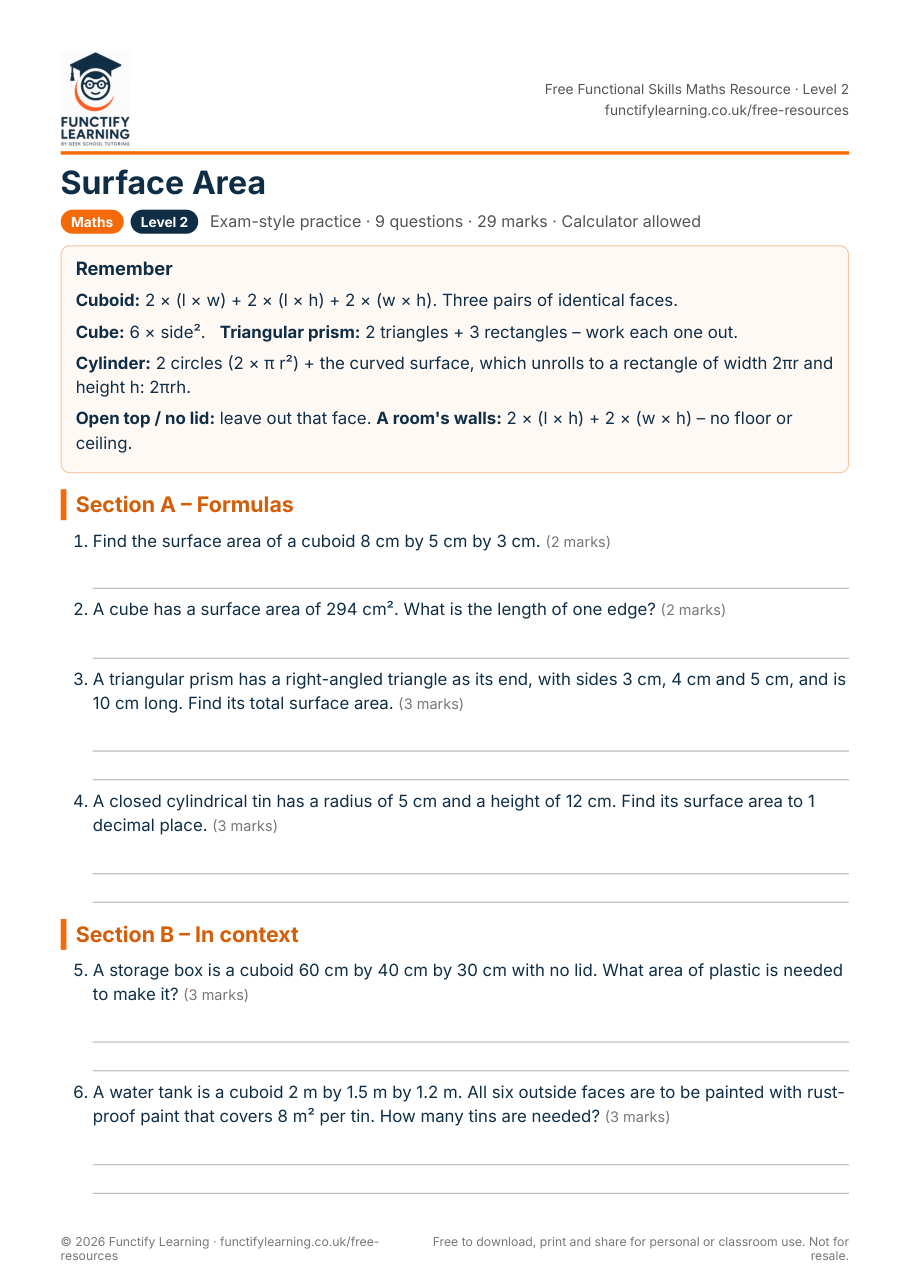
Free to download, print and share for personal or classroom use. Answers included.
What’s in this worksheet
- Section A – Formulas (10 marks)
- Section B – In context (19 marks)
- Revise box with the rules and methods for the topic
- Worked answers for every question
Common mistakes on this topic
From our tutors’ marking and the most recent examiner reports – check your work against these:
- Counting all six faces when the box has no lid, or including the floor and ceiling when only walls are painted.
- Confusing surface area (cm²) with volume (cm³) – if the question mentions paint, card, paper or vinyl, it is surface area.
- Using the diameter as the radius for a cylinder’s circles.
How to use it
- Print the worksheet (or work on screen) and attempt every question without looking at the answers. Give yourself a rough time limit – Level 2 exams are tight.
- Mark your work against the answer page. For maths, check the method as well as the final number; method marks are where most of the marks are.
- Read the ‘common mistakes’ notes below and check whether any of them happened to you. Then redo the questions you got wrong a day later.
Related free resources
- Volume Worksheet – Functional Skills Maths Level 2
- Plans and Elevations Worksheet – Functional Skills Maths Level 2
- Level 2 Maths Mini Practice Paper 1 – Functional Skills Maths Level 2
- All free Functional Skills Maths Level 2 resources
Frequently asked questions
What is the difference between surface area and volume?
Surface area is the total area of the outside faces, in square units – how much paint, card or paper covers it. Volume is the space inside, in cubic units – how much it holds. Paint questions are surface area; filling questions are volume.
How do you find the surface area of a cuboid?
Find the area of the three different faces (length × width, length × height, width × height), double each because faces come in identical pairs, and add. Leave out any face that is missing, such as an open top.
What is the curved surface area of a cylinder?
2 × π × radius × height. Unrolled, the curved surface is a rectangle whose width is the circumference of the circle and whose height is the cylinder’s height. Add the two circular ends if the cylinder is closed.
Want a tutor to mark your work? Not sure where you stand? Take the free 15-minute mini mock test. Ready to get qualified? Our live 10-week Functional Skills Level 2 Maths course runs in small groups with a mock exam included, and the 5-day revision course is there if your exam is close.