
Blog posts appear on every board’s papers and are easy to underestimate: they look casual, but they are marked on the same grids as a letter. The skill is a personal voice with proper structure. This free pack gives you two blog tasks in exam layout, the grids explained, and a model post annotated to show how voice and structure work together.
Free to download, print and share for personal or classroom use. Answers included.
What’s in this worksheet
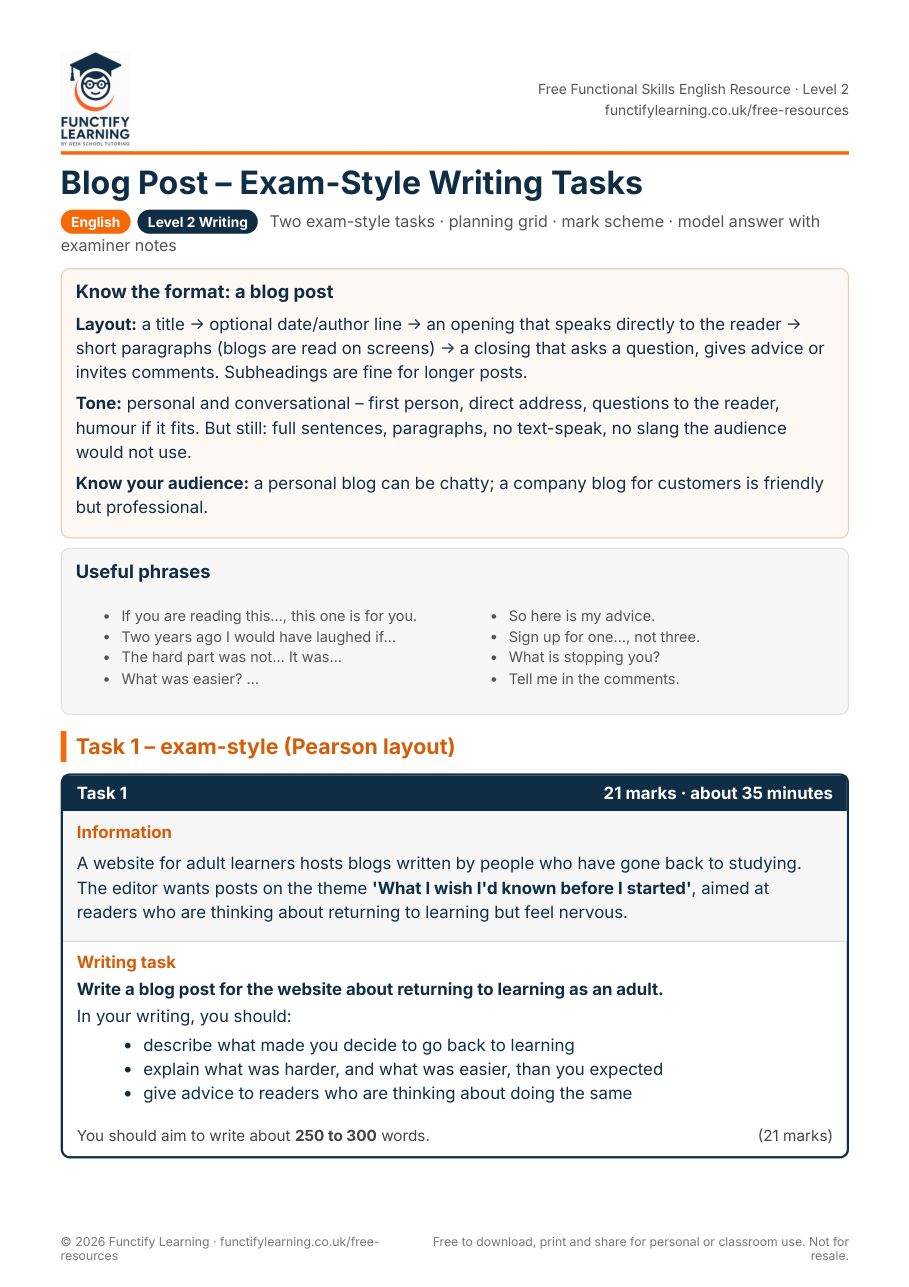
- Know-the-format box for this text type
- Task 1 in Pearson exam layout (Information box, bullet points, word count, marks)
- Task 2 in Highfield exam layout (notes stimulus)
- Planning grid and lined answer space for both tasks
- Plain-English version of the official marking grids
- Indicative content list for Task 1
- 298-word model answer with examiner notes
Common mistakes on this topic
From our tutors’ marking and the most recent examiner reports – check your work against these:
- Writing it as a formal essay – no ‘I’, no ‘you’, no title. A blog without a voice loses format and register marks.
- Going too far the other way: slang, ‘lol’, no paragraphs. Conversational is not the same as careless.
- Answering ‘what was harder’ but forgetting ‘what was easier’ – both halves of the bullet count.
- No ending. Blogs finish with a question, a tip or an invitation, not mid-thought.
How to use it
- Read the ‘Know the format’ box, then do Task 1 under exam conditions – 5 minutes planning, the rest writing, timed as the task box says.
- Mark yourself against the grid and the indicative content list. Be honest about which band each strand lands in.
- Read the model answer and its notes, then rewrite your weakest paragraph. Do Task 2 a few days later without looking at the model.
Related free resources
- Review – Exam-Style Writing Tasks (Functional Skills Level 2)
- Web Forum Post – Exam-Style Writing Tasks (Functional Skills Level 2)
- Plan a Functional Skills Writing Task in 5 Minutes – Free Planning Sheet
- All free Functional Skills English Level 2 resources
Frequently asked questions
How formal should a blog post be in the Functional Skills exam?
Conversational but correct: first person, direct address and questions to the reader are all good, but you still need full sentences, paragraphs and accurate spelling. Think ‘talking to a friend who is a good writer’.
Does a blog post need a title?
Yes – a title is part of the format, and a good one signals the topic and the angle: ‘Back to the classroom at 34: what I wish someone had told me’. An author or date line underneath is optional but looks the part.
How should a blog post end?
With something that keeps the conversation going: a question to readers, a piece of advice, or an invitation to comment. It is one of the clearest ways to show the examiner you know the form.
Want a tutor to mark your work? Not sure where you stand? Take the free 15-minute mini mock test. Ready to get qualified? Our live 10-week Functional Skills Level 2 English course runs in small groups with a mock exam included, and the 5-day revision course is there if your exam is close.