
You cannot explain a language device until you can name it on sight. This free multiple-choice worksheet gives you twenty quotations to identify – from rhetorical questions and alliteration to personification and colloquial language – then ten questions on why a writer would choose each one. It is the foundation for the exam-style sheet.
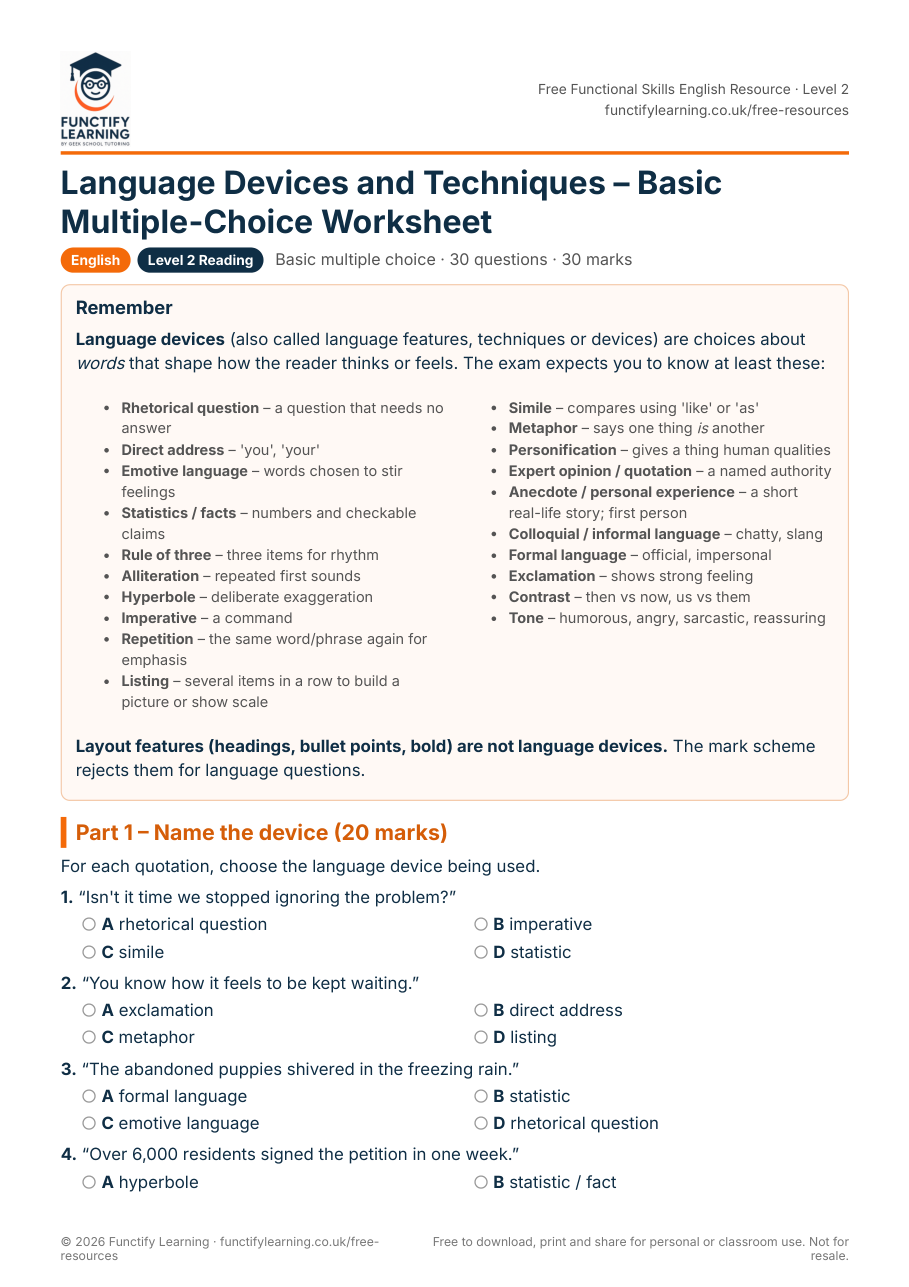
Free to download, print and share for personal or classroom use. Answers included.
What’s in this worksheet
- Part 1 – Name the device (20 marks)
- Part 2 – Choose the effect (10 marks)
- Full answers written as a mark scheme
Common mistakes on this topic
From our tutors’ marking and the most recent examiner reports – check your work against these:
- Confusing simile and metaphor: a simile uses ‘like’ or ‘as’; a metaphor says it is the thing.
- Calling every strong word ’emotive’. Ask whether the word is chosen to make the reader feel something.
- Offering a layout feature (bold, bullet points, heading) when asked for a language feature.
How to use it
- Do the basic multiple-choice sheet first, without notes, and mark it. Anything under 80% – reread the Remember box and redo the ones you got wrong.
- Then do the exam-style sheet with a time limit: about a minute per mark.
- Mark it using the mark scheme exactly as written – no half marks for vague answers – and note which question types cost you.
Related free resources
- Organisational Features – Exam-Style Questions – Functional Skills English Level 2
- Language Devices and Techniques – Exam-Style Questions – Functional Skills English Level 2
- Functional Skills English Level 2 Language Features Worksheet
- All free Functional Skills English Level 2 resources
Frequently asked questions
What language devices do I need to know for Functional Skills Level 2?
The core set: rhetorical question, direct address, emotive language, facts and statistics, rule of three, alliteration, hyperbole, imperatives, repetition, listing, simile, metaphor, personification, expert opinion, anecdote, and the difference between formal and informal language.
What is the difference between a simile and a metaphor?
A simile compares two things using ‘like’ or ‘as’ – ‘the queue moved like treacle’. A metaphor says one thing is another – ‘the town centre is a ghost town’. Both create a picture; the exam accepts either name if it is correct.
Are headings and bullet points language features?
No. They are organisational (layout) features. Exam mark schemes for language questions say ‘do not accept layout features’. Keep the two lists separate in your head.
Want a tutor to mark your work? Not sure where you stand? Take the free 15-minute mini mock test. Ready to get qualified? Our live 10-week Functional Skills Level 2 English course runs in small groups with a mock exam included, and the 5-day revision course is there if your exam is close.